Continuous insight
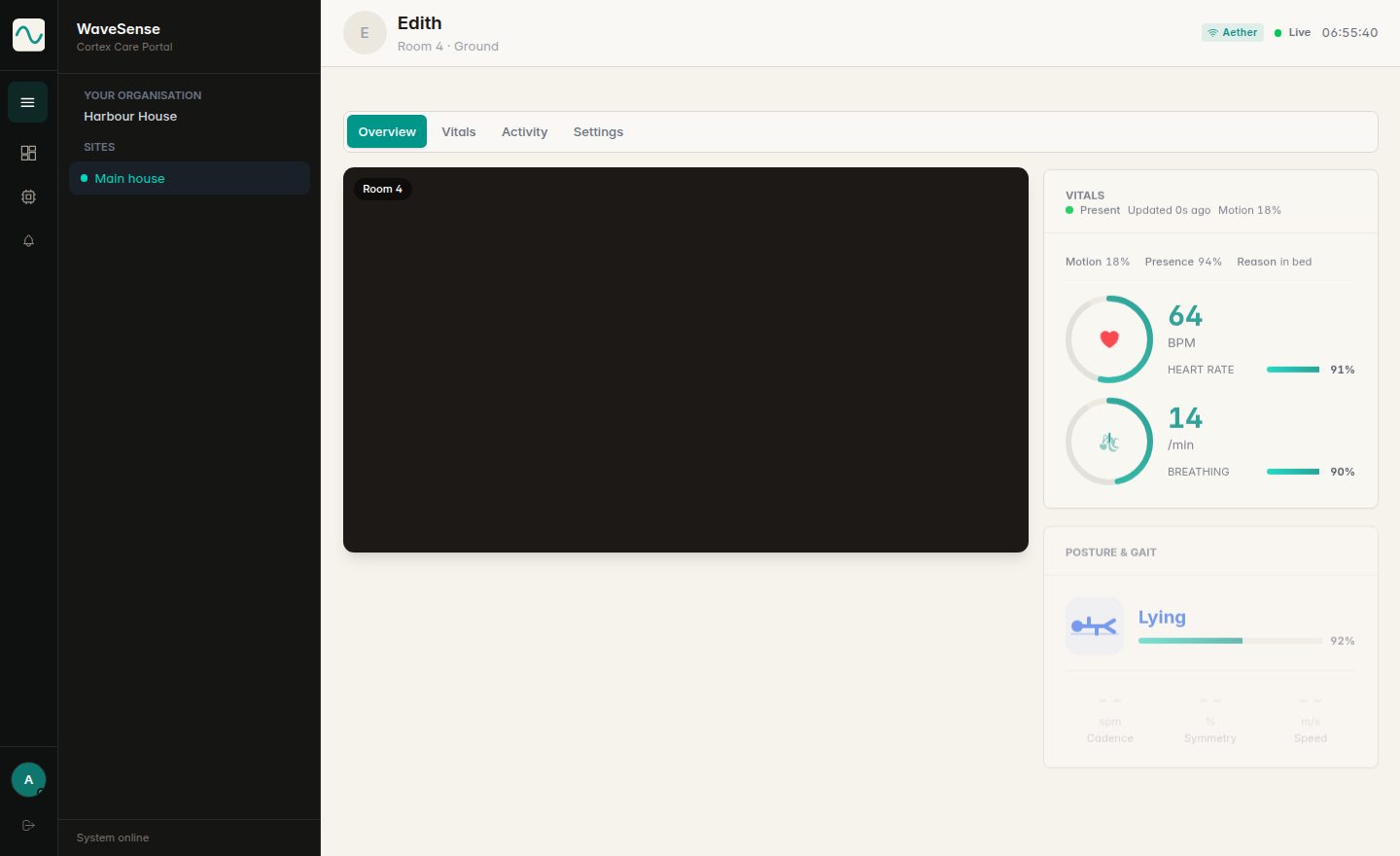
Breathing, heart rate, movement, presence and stillness, without asking the resident to wear or press anything.
A night-time care bedroom. A resident is asleep. Radio from two wall sensors moves through the room. There is no camera in this private room. A calm vitals readout sits beside the bed, and a carer phone receives a quiet check-in.
Now in pilot · UK care homes
WaveSense is one system for the whole home. Radio covers every room, and a camera sits only in the key spots. Care teams see presence, breathing, heart rate and movement, with nothing for the resident to wear or do.
What we offer
Radio quietly covers every room. A camera in the key spots follows movement and activity. Cortex turns both into a carer’s next action.
Breathing, heart rate, movement, presence and stillness, without asking the resident to wear or press anything.
PRECOG learns a personal baseline and flags drift, a change in rest, breathing or routine, before it is only an incident.
Radio covers the whole space, including private rooms, with no camera there. A camera is placed only in the key spots, for movement and activity.
Alerts and responses carry a time. The night between rounds is no longer a blank page in the care record.
The gap
Residents who are frail, living with dementia, or unable to speak cannot be the sensor. Night rounds have a gap. Deterioration does not wait for the next check.
They need a reach, a press, and a voice at the moment many residents are least able to do any of those. In a real fall, the button is often not what gets help moving.
They need charging, skin tolerance and a resident who keeps them on. A device in a drawer is not a night of monitoring.
A check every few hours is still a gap of hours. Breathing, heart rate and position can change long before the next door opens.
These are descriptions of how the tools are used in care, not results from a cited study.
Sensing
Radio covers every room, including private ones, with no camera there. A camera sits only in the key spots, following movement and activity. Aether is the small radio sensor for presence, breathing and heart rate. Radiant is the edge camera on a Jetson for sitting, lying, standing, and a fall or trip. Neither asks the resident to wear or do anything.
Aether
Wi-Fi-like radio fills the room. The reflections carry breathing, heartbeat and a body crossing the floor. The Aether radio itself uses no camera, microphone or wearable.
Aether · How it works
Two small sensors, and the room itself keeps watch. Breathing and heart rate show up in WaveSense. The radio uses no camera, and nothing for the resident to wear.
One above the bedside table, one under the window. Each plugs into a wall socket. A couple of minutes a room.
A QR code in the WaveSense app puts the sensor on the dashboard.
Radio moves between the two sensors, through the room and the person. No microphone, no worn device, nothing for the resident to do.
Chest-scale motion comes back out of the reflections. A soft outline shows where the body is. The radio itself has no camera.
Cortex learns this resident’s normal. A rise in breathing or a long stillness goes to the carer.
Device placed
The camera
Radiant
Radiant is the camera in the system, placed in key spots such as the lounge, a corridor or a dining room. Pose is inferred on the Jetson. Video is never stored. A live view is optional, encrypted, and limited to staff who are allowed to see it.
Radiant · How it works
A camera in a key shared spot, here the lounge, sitting at chest height. Pose is read on the device, and a trip is raised the moment it happens, so staff know the room.
On a sideboard or cabinet, in a key shared spot. It joins Cortex over the network you already have.
Pose runs on the device. Inference stays there. Nothing is written to a video archive.
Standing is green and sitting is blue, the same colours staff already know in Cortex.
A trip is raised at once for that lounge, so staff know exactly where to go.
The same alert can carry who is there, which room, and what their breathing was doing.
Camera in place
Together
Radio quietly covers every room, and a camera watches only the key spots. Together they follow one person through their day, so staff get peace of mind wherever they are.
Aether sensors in every room follow presence, breathing and heart rate. Private rooms stay without a camera.
Radiant, on a small Jetson in the shared areas, follows movement and posture. Video is processed on the device.
Cortex joins radio and camera into one picture of the person as they move through the home: events and vitals, and no stored film.
Morning · Bedroom
Cortex
Cortex is the screen a carer actually uses. Radio contributes presence, breathing and heart rate from every room. The camera contributes movement and posture from the key spots. PRECOG sits on that history and watches for drift.
Pose is inferred on the device. Video is never stored. If a live view is switched on, it is optional, encrypted, and only available to authorised staff. It is a relayed view, not an archive.
Radio throughout the home. A camera only in the key spots, where movement and posture matter.
Vitals and pose are worked out on the device. Cortex receives the result.
PRECOG builds one baseline per person, then watches the drift away from it.
A clear prompt in WaveSense. Live view, if enabled, stays permissioned.
PRECOG
Falls are visible. Slow deterioration is not. PRECOG is the predictive layer: it learns what normal looks like for each resident, then flags drift that can precede a worse night. That includes restlessness, breathing and time out of bed.
It does not diagnose. It gives a carer a reason to look sooner.
A breathing rate means something different for each resident. PRECOG treats the delta from that person as the signal.
The same sensors watch across days. That is what makes a trend visible, rather than a single noisy reading.
Check hydration, breathing, sleep, mobility or how yesterday’s care landed. The clinical judgement stays with the team.
Why WaveSense
Aether works in the dark, under bedding, with no image and no audio. Private rooms stay on radio, with no camera.
Population thresholds create noise. The model that matters is the one that knows this resident’s nights.
The Aether radio has no video. Radiant infers on the device and does not store video. Live view is optional, encrypted and permissioned. This is a design intent, not a certification.
Each home adds real nights: baselines, alerts and what staff did next. That history is what PRECOG learns from.
Another bed does not require another overnight post. The economics sit with devices and the dashboard, not with more footsteps.
Sensing, on-device models and Cortex are built together. The critical path is not a chain of third-party sensor APIs.
Compared with the usual tools
| Capability | Pendant | Wearable | Camera alone | WaveSense |
|---|---|---|---|---|
| Works without the resident acting | No | Partial | Yes | Yes |
| Breathing and heart rate | No | If worn | No | Aether |
| Suited to a private bedroom | Yes | Yes | Rarely | Radio, no camera |
| Movement in the key spots | No | No | Varies | Radiant |
| Personal baseline | No | No | No | PRECOG |
| Video kept off disk | n/a | n/a | Often stored | Not stored |
“Designed for UK GDPR” describes product intent. It is not a certification, and this table is not a legal comparison of other companies.
Get started
We are running a limited number of pilots with UK care homes. A quiet install, then real nights, and no extra routine for residents.